
ROME, Italy — The dream was already there.
Long before Ricards Aizpurs arrived in Fort Worth, before he put on a TCU uniform, before his name appeared on the Horned Frogs' 2026-27 roster, he had already decided that college basketball was where he wanted to go.
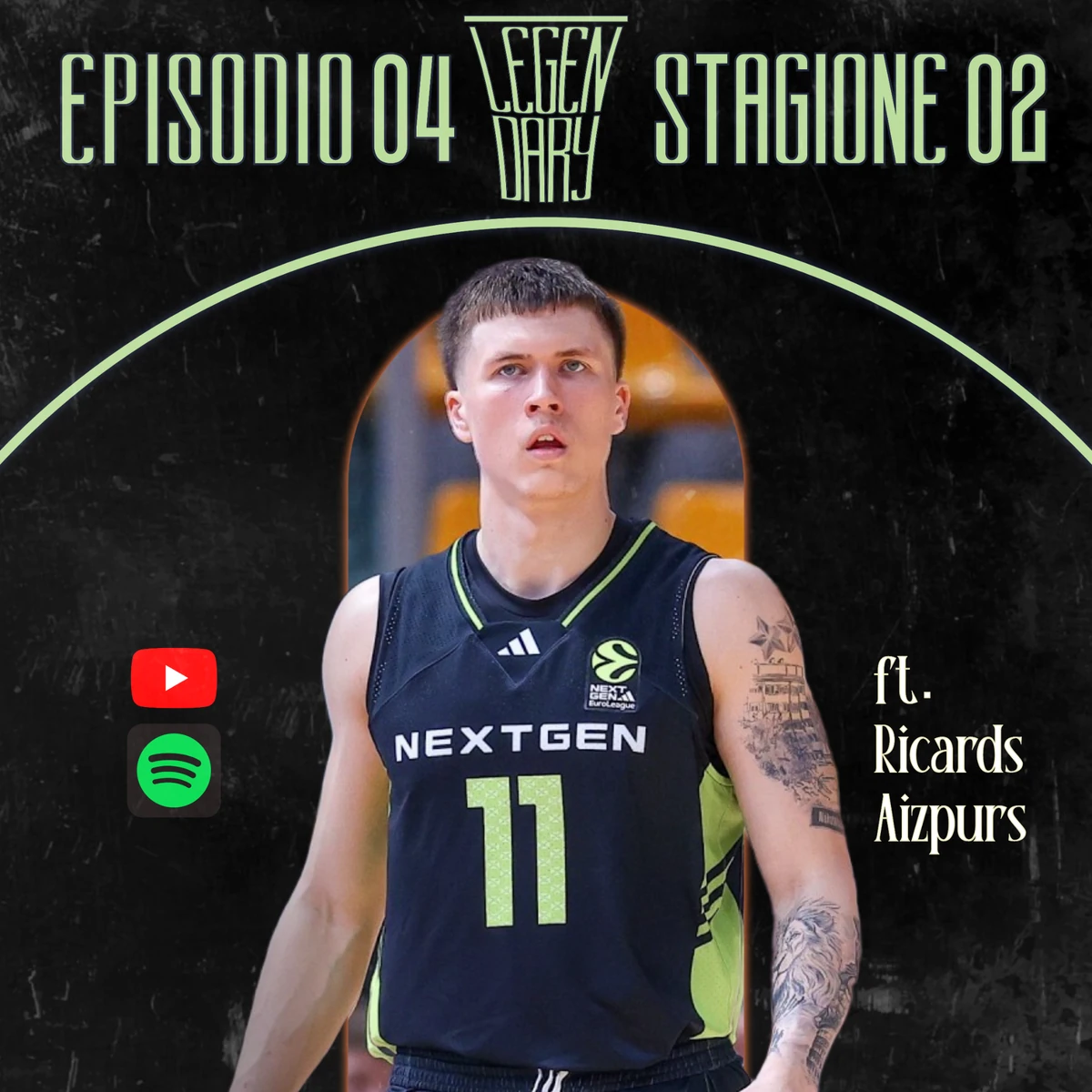
When Legendary – Italian podcast focused on the future of Italian basketball – sat down with Aizpurs in Rome this summer, the Latvian wing was still preparing for the next step in his career. He had spent the previous years developing at Stella Azzurra, one of Europe's premier basketball academies, competing against elite international prospects and testing himself at Basketball Without Borders.
He knew what he wanted.
He just didn't know yet that his next basketball home would be Fort Worth.
"The college was my dream," Aizpurs said during the interview.
Now, that dream has become reality.
TCU added Aizpurs to its 2026-27 roster in June, bringing in a 6-foot-6 Latvian guard from Stella Azzurra. He will wear No. 8 for the Horned Frogs.
A Basketball Journey That Started Late
Perhaps the most intriguing part of Aizpurs' story is how recently basketball entered his life.
He did not grow up assuming he would become a professional player. In fact, when he was younger, basketball wasn't even part of the plan.
"I didn't even think I was going to play basketball," Aizpurs said. "I thought I was going to do something else. But when I caught the ball in my hands, I understood that basketball was my sport."
That realization eventually took him from Latvia to Rome.
When Stella Azzurra invited him for a tryout, Aizpurs traveled to Italy with his father for three days. He remembers being so impressed by the environment that he asked his father if he could buy a Stella Azzurra jersey.
His father told him not to worry about it.
Two days after they returned home, the offer arrived.
Aizpurs was going to Rome.
"Stella Azzurra became my second home," he said. "Maybe even my first home."
The adjustment was significant. He arrived without speaking Italian and initially found himself on the outside of conversations with teammates.
Learning the language became part of his development.
"When I learned Italian, I felt more like one of them," he said. "I felt more Italian and I became part of the group."
Four years later, the academy had helped shape much more than his basketball game.
"I don't think I could be the Ricards I am today without Stella Azzurra," he said.
The Test of Playing Against the Best
Aizpurs' résumé before arriving at TCU already included experiences that most 17-year-olds have never encountered.
He played at Basketball Without Borders in Europe before earning an invitation to the global camp in Los Angeles, where he competed alongside the top prospects in the world from his class.
The setting was a glimpse of the basketball world he hopes to enter.
NBA coaches ran workouts. NBA players shared experiences. And suddenly Aizpurs was no longer simply one of the best players in his own gym.
He was surrounded by players with the same ambitions.
"We trained with NBA coaches, and we saw NBA players who came to teach us and share some of their experiences," he said.
The names around him were almost surreal: Victor Wembanyama, Kevin Durant, Austin Reaves, Danilo Gallinari and Pascal Siakam were among the NBA players he encountered.
But the most important part of the experience wasn't the star power.
It was the competition.
"Maybe on your team at home you are the strongest player," Aizpurs said. "But if you play against 40 of the best prospects in the 2008 class, you can have some difficulties."
Then came the lesson he took from it.
"You have to play against people who are better than you to improve."
That mentality is one reason the transition to American college basketball makes sense for Aizpurs.
A 6-Foot-6 Guard Who Wants to Play Through Contact
TCU's official roster lists Aizpurs at 6-foot-6 and 220 pounds, giving the freshman an intriguing physical profile for a perimeter player.
His natural game is aggressive.
He wants to get downhill.
He wants contact.
And when the lane opens, he wants to finish above the rim.
"When I jump, I feel like nobody can stop me," Aizpurs said. "If the defender doesn't jump, I dunk. If he jumps, I try to put my body on him and finish."
That physicality is already one of the foundations of his offensive game.
But Aizpurs knows that the next level will require more than simply overpowering defenders.
He has spent significant time developing his midrange game, his ability to use his body and his reads out of pick-and-roll situations.
"The bump is one of the things I've worked on the most," he said. "With the bump, you can create space and you can also get to your midrange."
He specifically mentioned studying Boston Celtics guard Payton Pritchard's ability to use his body to create advantages.
That detail is important.
Aizpurs isn't simply trying to become stronger. He's trying to understand how strength can become a skill.
The Next Step: Seeing the Game
One of the most revealing portions of the interview came during the film session segment, where Aizpurs broke down his own game.
He talked openly about the areas he needs to improve — particularly his ballhandling, his ability to keep his head up in pick-and-roll situations and his comfort navigating physical contact.
"I like playing pick-and-roll because, if you do it well, it's almost impossible to defend," he said.
But he understands that college basketball will force him to process those situations faster.
That is where development becomes more than shooting hundreds of jumpers in an empty gym.
"I believe in individual development a lot," Aizpurs said. "But you have to work on situations that you will actually see during games."
His philosophy is simple: practice should make game situations feel easier.
"You have to get out of your comfort zone during individual workouts," he explained. "You work on different shots, even harder ones than you will take in a game. Then, during the game, when you do those things, they feel comfortable."
For a player making the jump from European youth basketball to the Big 12, that mindset could prove particularly valuable.
He Already Thinks Like a Clutch Player
There is another trait Aizpurs brings with him to Fort Worth: confidence.
Ask him about late-game situations and he doesn't hesitate.
"I feel like I'm a clutch player," he said.
His explanation is rooted in how defenses operate.
"At the end of games, the defense will already know who the best player is and they will try to take him away. If I create an advantage, I can pass the ball. But if nobody comes, I can be the clutch player who takes the important shot."
The confidence comes from repetition.
"I always have confidence in my shots," Aizpurs said. "When I take a shot, I always believe it's going in."
That confidence will now be tested against Big 12 defenses.
And that is precisely what Aizpurs wanted.
From a Dream to Fort Worth
When the interview took place, the destination was still unknown.
But the goal was clear.
"I want to play college," Aizpurs said. "It was my dream."
He also understood that the value of college basketball extended beyond the court.
"It's not because they pay you or because you can become famous," he said. "For me, it's about playing against the best players and also about the college experience."
He wanted the competition.
He wanted the independence.
He wanted the opportunity to learn.
And eventually, he wants the NBA.
Asked where he saw himself five years later, his answer was as bold as it was uncomplicated.
"Five years from now, I see myself as an NBA player."
But there was another goal attached to that ambition.
"I want to grow basketball in Latvia," Aizpurs said. "I want to be the player that the little kids look at and say, 'I want to be like Ricards.'"
Now, the first major American chapter of that journey is about to begin.
TCU officially added Aizpurs in June, as an international addition to the 2026-27 roster. He joins the Horned Frogs after establishing himself as one of the more intriguing young prospects in European basketball.
The numbers behind that résumé are eye-catching. In Italian U17 competition during the 2024-25 season, Aizpurs averaged 33.6 points per game, while also averaging 18 points per game playing up at the U18 level as a 16-year-old. He also averaged 18.1 points, 3.4 rebounds and 2.4 assists for Latvia at the 2024 FIBA U16 EuroBasket.
But statistics only tell part of the story.
The more interesting part is the player behind them.
A Latvian teenager who only discovered basketball a few years ago.
A kid who crossed Europe to learn a new language and build a new life.
A young wing who went to Los Angeles to compete against the best prospects in the world.
And a player who, even before knowing where his college career would begin, had already made his ambition clear.
"I want to be an NBA player."
Now he gets to start chasing that dream in purple.
Fort Worth is next.